



We create a clear basis for focused R&D projects.
Contact


The implementation of the previously developed strategy takes place within the framework of special research and development projects. These projects are funded by European programs such as Horizon 2020, the INSIDE Joint Undertaking, ITEA 4, or corresponding national funding programs. SafeTRANS plays a key role in this process by supporting the planning of project content through close cooperation with strategic decision-makers at the European and national levels.It helps identify suitable project partners and form strong consortia by bringing together national stakeholders with international clusters, industry partners, and research institutions. In addition, SafeTRANS contributes to the quality of project proposals by ensuring that they are consistent with overarching research strategies. In all phases, SafeTRANS acts as an initiator, supporter, and reliable partner for R&D projects
An overview of the projects in which we played a key role and which have been successfully completed.
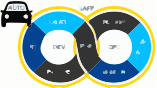
Die Digitalisierung im Fahrzeug stellt einen wesentlichen Innovationstreiber mit hoher wirtschaftlicher Bedeutung für den Standort Deutschland dar. Mit der Umsetzung von hochautomatisierten und autonomen Fahrfunktionen ergeben sich dabei einerseits hohe Anforderungen an den Nachweis von Sicherheitseigenschaften dieser Systeme. Andererseits wird die Fähigkeit, Fahrzeugfunktionen auch nach der Auslieferung zu aktualisieren, ein zentraler Schlüssel für die Sicherheit, Leistungsfähigkeit, Effizienz und somit auch die Kundenakzeptanz sein. Aktualisierungen ergeben sich nicht nur aus der Anforderung, Korrekturen und Leistungsverbesserungen durchführen zu können, sondern auch aus der sich zunehmend entwickelnden Vernetzung und Integration mit der Verkehrsinfrastruktur, bei der Fahrzeuge in Zukunft für die Durchführung der Fahraufgabe auf externe Informationen und Datenverarbeitung zurückgreifen werden. Bis heute fehlt hierfür ein ganzheitlicher Ansatz, welcher modulare Updates inklusive der zugehörigen Absicherungsprozesse und Verfahren über die Systemgrenze zwischen Fahrzeug(en) und Infrastruktur bzw. Backend in einer sich dynamisch verändernden Umwelt ermöglicht.
Im Rahmen der Ausschreibung „Elektronik und Softwareentwicklungsmethoden für die Digitalisierung der Automobilität (MANNHEIM)“, Förderlinie C (Methoden und Werkzeuge für die Softwareentwicklung in automobilen „Systems of Systems“) plant der Forschungsverbund AutoDevSafeOps aus führenden Unternehmen entlang der gesamten Wertschöpfungskette, sowie Universitäten und Forschungsinstituten im Bereich der sicherheitsorientierten Forschung, die Erforschung von Prozessen, Methoden und Technologien für sichere, modulare Updates von Fahrzeugsystemen. Die Ergebnisse, sowie der konkrete Nutzen werden dabei in vier Anwendungsbeispielen (Use Cases) evaluiert und demonstriert.
Die Erprobung der entwickelten Ergebnisse findet unter der Maßgabe der industriellen Anwendbarkeit statt, und umfasst wesentliche Bestandteile des sicherheitsorientierten Entwicklungsprozesses in einem DevOps-Zyklus: Spezifikationen, Methoden zur Durchführung und zur Absicherung von Entwurfsschritten, Mechanismen der Rechnerplattformen und der Middleware, Durchführung von Updateprozessen, Absicherung und Überwachung zur Laufzeit der Systeme, sowie die konsistente Integration dieser Entwurfsschritte. Parallel dazu werden Nachweisverpflichtungen in dem Gesamtprozess, im Sinne relevanter Sicherheitsnormen und Standards, untersucht und weiterentwickelt. Durch die Betrachtung neuartiger (u.a. KI-basierter) Fahrfunktionen in diesen Prozessen, sowie der Nutzung externer Infrastrukturen sowie Backenddienste im Fahrzeug werden in dem Forschungsverbund gleichzeitig hoch innovative Ansätze mit hohem wissenschaftlich-technischem und wirtschaftlichem Risiko untersucht.
Die Partner des Forschungsverbundes können auf umfassende Vorarbeiten in den relevanten Anwendungs- bzw. Forschungsgebieten aufbauen und haben langjährige Erfahrung über die komplette Wertschöpfungskette von der Grundlagenforschung bis hin zur industriellen Anwendung. Somit kann dieses Projekt einen wichtigen Baustein für modulare, die bisherigen Systemgrenzen überschreitende, Updates von sicherheitskritischen Fahrfunktionen liefern - einer Schlüsseltechnologie mit hoher strategischer Bedeutung für die Wettbewerbsfähigkeit und Innovationsdynamik des Hochtechnologiestandorts Deutschland.
Independent validation is fundamental to emphasise the capability and safety of any solution in the electric, connected and automated (ECA) vehicles space. It is vital that appropriate and audited testing takes place in a controlled environment before any deployment takes place. As the software and hardware components come from multiple vendors and integrate in numerous ways, the various levels of validation required must be fully understood and integration with primary and secondary parts must be considered.
The key targets of ArchitectECA2030 are the robust mission-validated traceable design of electronic components and systems (ECS), the quantification of an accepted residual risk of ECS for ECA vehicles to enable type approval, and an increased end-user acceptance due to more reliable and robust ECS. The proposed methods include automatic built-in safety measures in the electronic circuit design, accelerated testing, residual risk quantification, virtual validation, and multiphysical and stochastic simulations.
The project will implement a unique in-vehicle monitoring device able to measure the health status and degradation of the functional electronics empowering model-based safety prediction, fault diagnosis, and anomaly detection. A validation framework comprised of harmonized methods and tools able to handle quantification of residual risks using data different sources (e.g. monitoring devices, sensor/actuators, fleet observations) is provided to ultimately design safe, secure, and reliable ECA vehicles with a well-defined, quantified, and acceptable residual risk across all ECS levels. The project brings
together stakeholders from ECS industry, standardization and certification bodies (e.g. ISO, NIST, TUEV), test field operators, insurance companies, and academia closely interacting with ECSEL lighthouse initiative Mobility.E to align and influence emerging standards and validation procedures for ECA vehicles.
The project dealt with the assurance and validation of updates in the field of highly automated vehicles, ships, and production facilities. High safety requirements apply to these systems; your operation must not pose a risk to people, the environment or property. Modern development and validation techniques, such as Continuous Design/DevOps methods, require the ability to update these systems, i.e. new (software) modules developed after the systems are put into circulation – to correct errors, increase system performance or even introduce new functionalities – must be transferred to the systems in the field and integrated there. This must not impair the safety properties of the system, so that safeguarding methods for such updates for systems already in the field become necessary.
The research partners of the project (OFFIS, DLR, KIT, FZI) have developed both a development and test process that enables such updates and their safeguarding, as well as several technology and method "building blocks" for implementing this methodology. The developed results were closely reviewed with members of an Industrial Advisory Board, which consisted of experts from companies familiar with the development and validation of highly automated vehicles, ships, and production facilities, and thus checked the applicability of the developed methods.
SafeTRANS coordinated and carried out the setup as well as the coordination and harmonization of activities with the Industrial Advisory Board in Step-Up!CPS and thus realized an open innovation process for Step-Up!CPS through further network activities.
Duration: 01.10.2018. - 30.09.2021
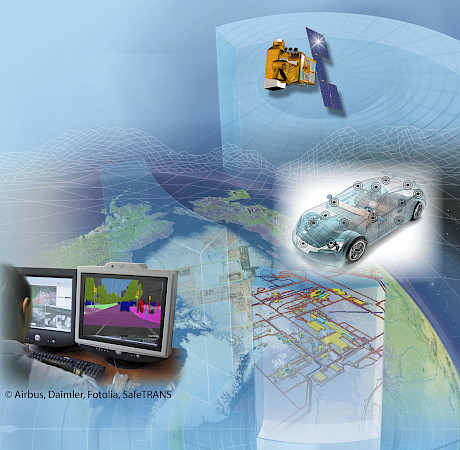
ENABLE-S3 was a European research project with the aim of developing a cross-domain platform for cost-efficient verification and validation (V&V) of autonomous cyber-physical systems (ACPS).
The ENABLE-S3 project developed methods and tools for the efficient security of autonomous systems – for example in the automotive, aviation, rail or medical sectors. The goal is to make tests and simulations more cost-effective and reliable, so that autonomous systems become safe, trustworthy, and faster to market.
Duration: 01.06.2016 - 30.04.2019